|
|
|
Happy Friday!
October 16, 2026
|
|
|
|
This week, we want to invite you to join Energy Right for Beer, Batteries, and Bees on Thursday, October 29, from 5:30 to 7:30 p.m. at Ironpipe Alewerks in Orange, Virginia. This free event brings together food, film, and conversation around renewable energy, the battery storage that goes along with it, and how energy development can work with agriculture and our natural environment.
We’ll kick things off with a screening of Pastures to Panels: The Power of Agrivoltaics, followed by a panel featuring a local beekeeper, a battery storage developer, and an environmental organization.
This event is free and open to everyone—you can RSVP here.
|
|
|
|
|
|
The M.C. Dean Expansion:
Energy Security Needs in Virginia
|
 |
|
|
|
This week, M.C. Dean and Governor Spanberger announced M.C. Dean’s $412.5 million expansion of its manufacturing campus in Caroline County—not only is this a major investment in Virginia’s economy, but a massive investment in the energy sector. M.C. Dean is an engineering and technology company that builds complex electrical power systems. The expansion is anticipated to add two manufacturing facilities and create nearly 2,000 permanent jobs in Caroline County, increasing the company’s ability to produce more power and technology systems that will help energy projects come online more efficiently. With the rise of data centers across Virginia, this investment reflects the growing need for more infrastructure to support Virginia’s expanding energy needs.
The expansion highlights the importance of strengthening the systems that deliver and manage electricity. As the Commonwealth continues to attract new businesses and expand advanced manufacturing, ensuring an adequate and reliable power supply will be essential to long-term economic competitiveness. Companies like M.C. Dean help build the electrical infrastructure that supports these facilities, but Virginia must also ensure it has enough generation to power them. That means advancing a diverse mix of energy resources, modernizing the grid, and supporting the infrastructure needed to deliver electricity where it is needed. Economic development and energy security go hand in hand: Virginia must not only attract businesses and create jobs, but also build enough reliable, affordable power to sustain that growth.
Building large-scale manufacturing capacity here in Virginia strengthens our energy security by helping ensure that the equipment and expertise needed to support critical electrical infrastructure are available closer to home. Investing in local manufacturing will reduce Virginia’s reliance on outside sources for essential components as energy demand continues to rise. As we work to keep pace with data centers, advanced manufacturing, and broader economic growth, we must prioritize both the infrastructure that delivers electricity and the generation resources that produce it. Expanding domestic manufacturing alongside responsible development of an all-of-the-above energy mix can help position Virginia to meet its growing energy needs, support long-term economic stability, and maintain a reliable, affordable power supply for businesses and families.
|
|
|
|
|
|
FROM THE ROAD
|
 |
|
|
|
Last week, Energy Right visited Louisa County to share with Planning Commissioners the importance of strengthening the grid with energy storage projects. The commission considered a well sited project, but unfortunately turned the project down. It’s very important for local governments to learn about Battery Energy Storage Systems before taking a vote. Energy Right is happy to facilitate BESS site tours for interested leaders.
|
|
|
|
What We’re Thinking
|
 |
|
Agrivoltaics as Economic Development
|
 |
|
|
|
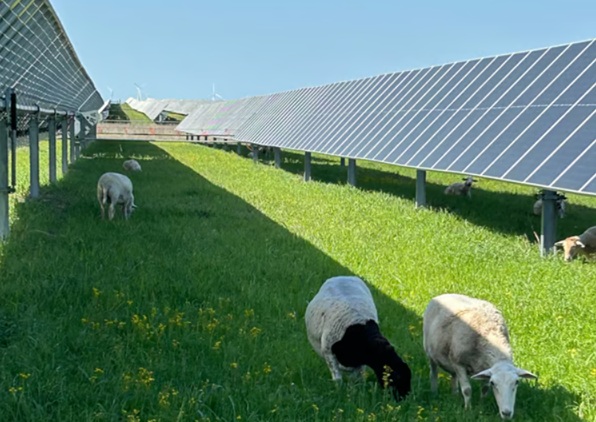
As solar development expands across the Commonwealth, a common question from local officials and residents alike is what happens to land once solar arrays are installed. Cornell University recently published research that offers useful conclusions to this dilemma. In the three-year study published this month, researchers compared sheep grazing with traditional mowing at a community solar farm in New York, testing different stocking rates, or the number of sheep allowed to graze a given area of land. At about two sheep per hectare (roughly 2.5 acres), populations of beneficial insects such as bees and beetles rose by 38% compared with mowed sites. When researchers implemented a higher stocking rate, vegetation was managed more efficiently, but fewer insects, such as bees, were supported. This helps developers and landowners understand the benefits and drawbacks of different land-management methods. A separate study by Cornell introduced planning tools that help sheep farmers manage their flock around solar contracts, and aid developers in writing agreements that will work for both parties involved over the lifespan of the project.
The economic benefits are significant. Currently, half of the lamb and mutton consumed in the U.S. is imported, and researchers see solar grazing as a way to expand domestic production. A solar grazer in New York expressed that solar grazing allows farmers to get paid to graze rather than paying for pasture. This is already occurring in Virginia; for example, Grays’s LAMBscaping has grown its flock to roughly 1,300 sheep by grazing around 4,000 acres of solar land. For local leaders, this research points to a strong middle ground where solar and agriculture can coincide. As local governments update ordinances or review project proposals, officials should consider how grazing and pollinator habits can keep land in agricultural use while creating a separate income stream for farmers in their communities.
At the state level, Virginia is already taking action. Earlier this year, the General Assembly passed HB 508 and SB 340 with bipartisan support, giving agrivoltaics, the practice of pairing solar generation with active farming on the same land, its first official definition within state code. The law, signed by Governor Spanberger, sets clear expectations. Qualifying projects must prioritize agricultural productivity, include decommissioning agreements that protect soil, and keep the land productive for the project’s lifespan. Virginia is the fourth state to pass agrivoltaics legislation, and the definitions lay the groundwork for future incentives. With a state framework now in operation, research such as Cornell’s shows what properly managed grazing can achieve. Localities can implement projects that support Virginia’s growing energy needs while stabilizing its agricultural economy.
|
|
|
|
|
|
|
|
|
|
|
|
This week, the team was in Hanover, King George, and Orange counties!
|
|
|
|
|
|
|
|
|
|
Virginia’s growing electricity demand is putting new attention on the challenges of bringing solar and battery storage projects online. At a Charlottesville energy forum, UVA researcher Elizabeth Marshall reported that localities have approved more than 16,000 MW of solar, but projects take an average of 1,000 days to reach operation after local approval.
State leaders emphasized affordability, reliability, and local energy development, while researchers highlighted interconnection delays, rising costs, and the need for better project tracking to help Virginia meet future demand.
|
|
|
|
|
WHAT NEXT?
|
|
|
|
NEXT WEEK
We’ll be going to Charlottesville, Frederick, Orange, and Spotsylvania.
|
|
|
|
|
|
|